Distinguish surface wear from movement
The decision to repair or replace a concrete driveway starts with the problem the work needs to solve. A worn surface, a broken edge and a displaced panel are not interchangeable defects. Covering them with the same treatment can improve appearance while leaving the reason for the damage untouched.
Begin with observations you can describe: where the concrete is worn, whether adjoining panels sit at different heights, whether water collects and whether a previously repaired area has changed again. Those observations help define an assessment. They do not, by themselves, identify the condition of the ground beneath the slab.
Surface defects
Pitting, scaling and a roughened wearing face concern the surface layer. A suitable repair or resurfacing system may address that layer, provided the underlying concrete and preparation meet the product's requirements. Cosmetic wear alone is not proof that the whole driveway must be removed.
It is also important to distinguish an unsightly surface from one that cannot provide the required function. If the main concern is appearance, compare treatments that address appearance. If the driveway no longer drains or meets the garage properly, the decision needs to include levels and layout rather than only the finish.
Displacement and recurring cracks
When one panel stands above another, the problem includes a difference in elevation. A thin coating does not rebuild the support below that panel. Likewise, a crack that reappears after a surface repair may reflect continuing movement rather than simply an inadequate-looking patch.
The NRMCA guide to concrete surface cracking describes several mechanisms behind cracks, including dimensional changes and support conditions. There is no single visual rule that identifies all of them. Avoid turning a photograph or a measured crack width into a universal replacement verdict.
Compare remedies by what they actually change
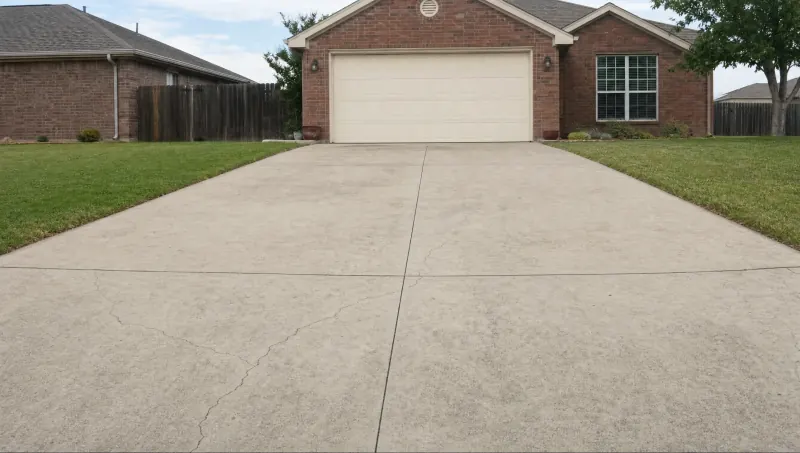
A useful comparison separates the wearing surface, the slab and the support beneath it. Different work reaches different layers. That distinction matters more than whether a proposal uses words such as repair, restoration or renewal.
Resurfacing
A resurfacer creates a thin new wearing surface over existing concrete. Preparation and compatibility are central to its performance. The original slab remains in place, so its condition still matters after the new surface is applied.
QUIKRETE's Re-Cap data sheet, for example, requires cleaning and repairs before resurfacing, preservation of existing joints and attention to the application conditions. It also warns that movement in the base concrete can cause cracks to appear in the resurfaced layer. That is a product-specific example of why resurfacing and rebuilding are different operations.
Replacing selected panels
Replacing part of a driveway changes the affected concrete while retaining the rest. It can be a meaningful comparison when the problem is limited and the retained layout still works. The removal boundary, meeting elevations and joint layout need to be part of the proposal.
Retaining concrete is not automatically a saving worth accepting. If the retained area creates an unsuitable height or drainage transition, the project may still need a broader change. Conversely, removing sound areas purely because another panel is damaged needs a reason tied to the intended result.
Full removal and replacement
Removal exposes the area beneath the old slab and creates an opportunity to correct support or redesign the footprint. It also brings demolition, disposal, temporary access and a new curing period into the project. Those are practical consequences, not reasons to select replacement before understanding the problem.
When the required result includes correcting the slab's support or substantially changing the layout, concrete driveway replacement is the appropriate scope to examine. The proposal should explain which conditions will be addressed rather than promise that new concrete can never crack.
Check what must remain sound
A treatment placed over existing concrete depends on the surface it bonds to. Loose material, contamination, incompatible coatings and uncorrected damage can interfere with that connection. Product instructions therefore describe preparation as part of the repair, not an optional cleaning step.
Do not assume every resurfacing product works over every previous patch or sealer. The Re-Cap instructions, for instance, restrict application over certain coatings and fillers. A proposal involving an already-treated driveway should identify the existing material and the preparation needed for the selected system.
Existing joints and reflective cracks
Joints have a function beyond their appearance. Contraction joints create planned locations for shrinkage movement, while isolation joints allow adjoining elements to move independently. Covering those lines to make a driveway look seamless can conflict with the purpose of the joint.
A reflective crack is a crack that shows through a new surface because the underlying concrete moves or cracks beneath it. The new surface has not necessarily created the original movement. Understanding that mechanism helps distinguish a finish expectation from a structural repair.
Our guide to driveway control joints explains the different joint types. For a repair decision, the immediate question is whether the proposed treatment preserves the movement provisions that the retained concrete needs.
Drainage is part of suitability
If water collects because panels have changed elevation, renewing the texture does not automatically restore the intended slope. The finished surface must still connect properly with adjacent paving, the garage and the drainage path. Identify whether the proposal changes those levels or leaves them as they are.
Prepare a useful condition record
Sketch the driveway and mark the problem areas. Keep wide photographs showing the garage and street connection as well as close photographs of individual defects. Record the approximate dimensions of the affected panels and note whether the concern is appearance, access, drainage or a combination.
For a recurring issue, describe what changed and when you noticed it. A note that a patched line reopened is more useful than calling the entire driveway “bad concrete.” Observations should remain observations; they do not need an assumed soil diagnosis to be valuable.
Then compare each proposed remedy against the same desired result. A surface treatment might address appearance without changing the footprint. Selected replacement might remove a damaged section while preserving the rest. Full replacement can address a larger layout or support problem but involves more of the property.
The estimate comparison guide helps make retained areas, removal limits and preparation explicit. If extra parking is the main goal, also compare widening beside existing concrete. A condition assessment and a parking-layout decision are related, but one should not be mistaken for the other.
To describe your proposed work, send a driveway inquiry with the existing condition and the change you want. Do not interpret a surface photograph or this guide as a final diagnosis or a construction quote.